
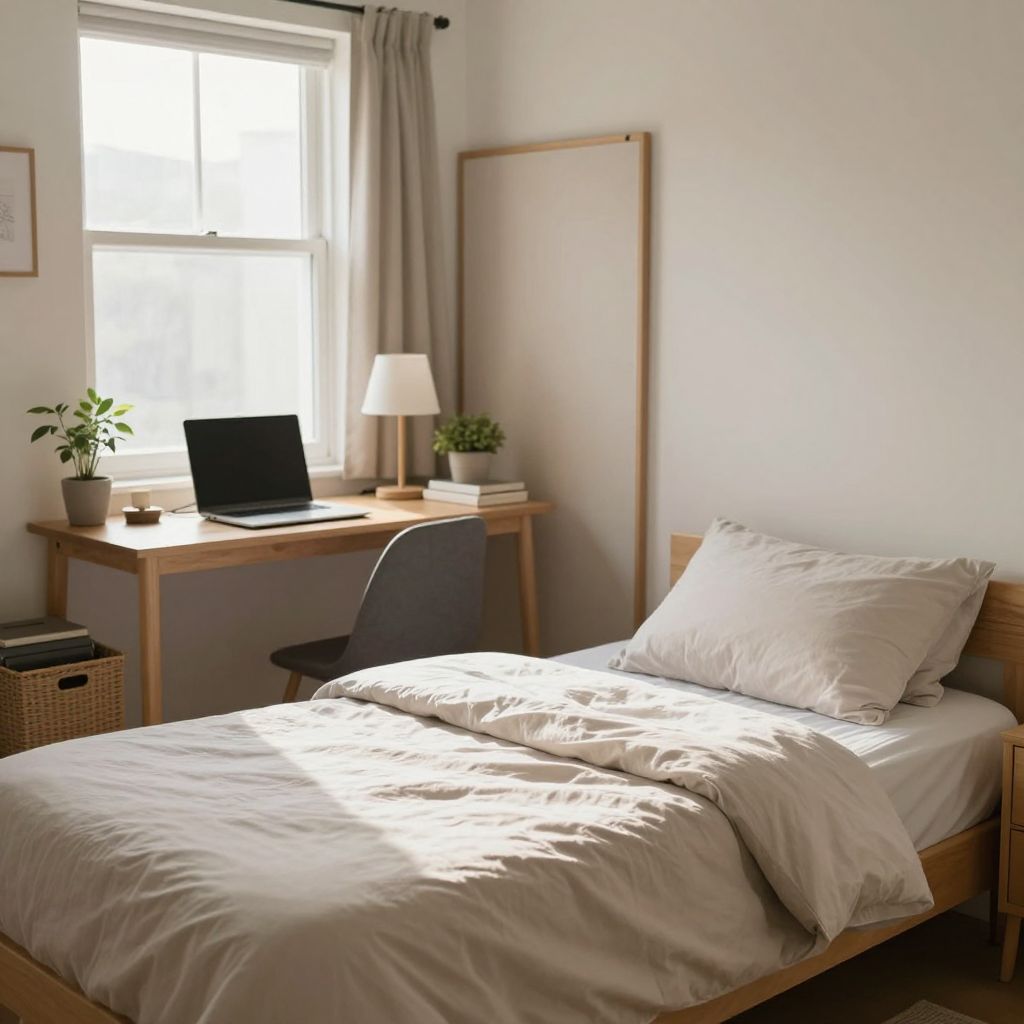
Shared space feels harder than it should. When you lack a room of your own, privacy becomes a negotiation, rest feels conditional, and the basic human need for solitude competes with whoever else shares your walls.
The absence of personal territory affects psychological wellbeing in measurable ways, but research also shows that people adapt remarkably well when they understand what they actually need and build strategies around those needs. This article explores how to reclaim autonomy, manage stress, and create the mental space you require even when physical space remains limited.
How Do You Deal With Not Having Your Own Room?
You deal with not having your own room by establishing portable boundaries, claiming temporal privacy through scheduled alone time, creating psychological ownership of specific zones, and developing mental practices that reduce dependence on physical isolation. Success depends less on square footage and more on deliberate strategies that meet core needs for autonomy, rest, and identity.
Understand What You’re Actually Missing
A room provides more than walls. It delivers control over stimulation, guaranteed solitude, and a stable environment where identity can express itself without negotiation.
Research on environmental psychology identifies three core functions of personal space: restoration from cognitive fatigue, regulation of social interaction, and identity expression through personalization. When you identify which function feels most compromised, you can target your efforts more effectively.
Ask yourself: Do you struggle most with overstimulation, lack of privacy, or inability to shape your environment? The answer determines your next move.
Separate Physical Space From Psychological Space
Territory exists in the mind before it exists on a floor plan. Psychologist Robert Sommer’s research on personal space demonstrates that humans create invisible boundaries even in shared environments.
You can claim ownership without walls by establishing consistent use patterns. The corner where you always sit, the shelf that holds only your items, the time block when others know not to interrupt—these become functionally yours through repetition and social agreement.
Consistency transforms shared space into recognized territory. Use the same spot daily and others begin treating it as yours.
Create Boundaries Without Walls
1. Establish Temporal Privacy
When physical privacy proves impossible, time becomes your most valuable resource. Scheduling specific hours for solitude works better than hoping space will spontaneously appear.
Negotiate dedicated alone time with roommates or family members. Frame this as mutual benefit: everyone deserves predictable periods of uninterrupted time, which requires coordination rather than competition.
Early mornings, late evenings, or specific weekday hours often provide natural gaps. Block these consistently and defend them as seriously as any appointment.
2. Use Portable Dividers
Physical barriers create psychological relief even when they don’t deliver complete privacy. Room dividers, curtains, bookcases, or strategically positioned furniture segment space and signal boundaries to others.
Studies on hospital privacy show that even partial visual barriers reduce stress and improve rest quality. The barrier doesn’t need to block sound or movement—it just needs to disrupt direct sightlines and create a sense of enclosure.
Position a bookshelf perpendicular to a wall, hang a tension-rod curtain, or use a folding screen. The division matters more than the method.
3. Deploy Sensory Control Tools
You can’t control shared space, but you can control your sensory experience within it. Noise-canceling headphones, sleep masks, white noise machines, and earplugs function as portable walls.
These tools don’t just block unwanted stimuli—they signal to others that you’re temporarily unavailable. Wearing headphones becomes a visual boundary that roommates learn to respect.
Combine sensory tools with consistent timing. When you put on headphones at the same time daily, others adapt their behavior around your pattern.
Maximize the Space You Have
Claim Vertical Territory
Shared rooms constrain horizontal space, but vertical space often goes unused. Shelving, wall hooks, hanging organizers, and lofted storage create personal zones above the contested floor area.
Environmental psychologists note that elevation provides psychological separation. Items stored or displayed above eye level feel more private and less subject to interference.
Install floating shelves for personal items, use over-door organizers, or create a vertical gallery of meaningful objects. Height equals distance in crowded quarters.
Develop a Mobile Personal Zone
When no fixed space belongs to you, build a kit that travels. A basket, bag, or box containing your essential items—headphones, journal, reading material, comfort objects—becomes your portable territory.
This container represents consistency in an inconsistent environment. You can move to whatever corner offers the most privacy at any given moment and immediately establish your presence.
Keep this kit complete and ready. The less friction involved in creating personal space, the more often you’ll actually do it.
Optimize for Flexibility
Rigid arrangements fail in shared environments because circumstances shift constantly. Design your space with modular, movable elements rather than permanent fixtures.
Folding furniture, stackable storage, and items on wheels adapt to changing needs. What functions as a desk in the morning can become open floor space in the evening.
Flexibility reduces conflict. When your setup doesn’t obstruct others’ needs, they’re less likely to encroach on yours.
Protect Your Mental Health
Recognize the Real Psychological Cost
Living without private space isn’t just inconvenient—it carries measurable mental health implications. Research on crowding shows increased cortisol levels, reduced cognitive performance, and higher rates of interpersonal conflict.
Environmental psychologist Gary Evans found that chronic exposure to crowding impairs executive function and self-regulation. These effects compound over time.
Acknowledging the legitimate difficulty validates your struggle and motivates sustainable solutions. This isn’t about toughness—it’s about addressing a genuine environmental stressor.
Build Restorative Routines
When your living environment doesn’t restore you, deliberate restoration becomes essential. Attention Restoration Theory explains that certain activities replenish depleted cognitive resources.
Natural environments, absorbing hobbies, and low-stimulation activities all restore mental capacity. Even brief exposure to nature, actual or simulated reduces stress markers.
Schedule daily restoration time outside your shared space: walks, library visits, sitting in parks, or time in cafes. These aren’t luxuries, they’re compensatory mechanisms for missing environmental support.
Practice Mental Boundary Setting
External boundaries prove easier than internal ones, but internal boundaries ultimately matter more. Meditation, focused breathing, and mindfulness practices create psychological privacy regardless of physical circumstances.
Studies on mindfulness show that regular practice reduces reactivity to environmental stressors. You become less dependent on external conditions for internal calm.
Start with five minutes daily. Close your eyes, focus on breathing, and practice returning attention to a single point whenever it wanders. This skill transfers directly to managing overstimulating environments.
Navigate Relationships in Shared Space
Communicate Needs Explicitly
Roommates and family members can’t respect boundaries they don’t know exist. Ambiguity breeds conflict, while explicit agreements create workable systems.
State your needs clearly and ask others to articulate theirs. “I need quiet time from 9 to 10 PM for reading” works infinitely better than sighing loudly when someone makes noise.
Frame requests as coordination rather than criticism. Everyone benefits from predictable expectations.
Respect Others’ Space Equally
Shared space functions as a commons, it degrades when anyone exploits it. The most effective way to secure respect for your needs involves consistently respecting others’ needs.
Social psychology research on reciprocity shows that cooperative behavior encourages cooperative responses. When you honor someone’s quiet hours, they’re more likely to honor yours.
Model the behavior you want to receive. Consideration becomes contagious in close quarters.
Address Conflicts Early
Small annoyances become major resentments when left unaddressed. Research on conflict escalation shows that early intervention prevents pattern solidification.
Raise issues while they’re still manageable. Use specific observations rather than character judgments: “When the TV stays on past midnight, I struggle to sleep” instead of “You’re inconsiderate.”
Most roommate conflicts stem from unspoken expectations rather than fundamental incompatibility. Conversation usually costs less than you fear.
Develop Location Independence
Identify Third Spaces
Sociologist Ray Oldenburg coined the term “third place” for locations beyond home and work that provide community and comfort. Libraries, coffee shops, parks, community centers, and religious buildings all serve this function.
When your home can’t meet all your needs, distributing those needs across multiple locations reduces pressure on any single space. You don’t need one place that does everything—you need a network of places that collectively provide what you require.
Map the third spaces in your area. Which offer quiet? Which welcome extended stays? Which cost nothing? Build a rotation.
Claim Outdoor Territory
Nature provides privacy without walls. Parks, trails, gardens, and waterfronts offer solitude, restoration, and space for thought at no cost.
Research on green space exposure shows significant mental health benefits even from brief nature contact. A 20-minute walk in a park reduces cortisol more effectively than the same time spent indoors.
Weather permitting, outdoor space often delivers better restoration than any indoor room. Make it part of your regular routine.
Use Institutional Resources
Schools, universities, and community organizations provide spaces specifically designed for individual work and study. These environments often offer better conditions than any bedroom.
Student centers, public libraries, and maker spaces provide desks, quiet rooms, and resources for free or minimal cost. Many stay open extended hours.
Treat these institutional spaces as extensions of your territory. Regular use establishes familiarity and comfort.
Reframe Your Relationship With Space
Separate Identity From Territory
Western culture strongly links identity to personal space, but this connection varies across cultures and proves more flexible than it initially appears. Your sense of self doesn’t require four walls.
Anthropological research on collectivist cultures shows that people develop strong identities in highly shared environments. The key involves internal rather than external markers of selfhood.
Invest in portable identity expressions: journals, digital collections, creative practices, or skill development. These travel with you and prove far more durable than any decorated room.
Focus on What You Control
Psychological research consistently shows that perceived control reduces stress more than actual control. When you identify the variables you can influence and release those you can’t, situations feel more manageable.
You can’t change your housing situation immediately, but you can change your schedule, your sensory environment, your communication patterns, and your restoration practices. Those changes accumulate into genuine improvement.
Direct energy toward modifiable factors. Everything else becomes noise.
View the Situation as Temporary
Even if your current arrangement continues for years, framing it as temporary rather than permanent changes your psychological relationship to it. Research on temporal framing shows that viewing hardships as finite increases resilience.
This isn’t about denial—it’s about maintaining perspective. Housing situations change, circumstances evolve, and the skills you build now transfer to every future living arrangement.
Treat this as a training ground for adaptability rather than a permanent condition. That shift in framing matters.
Build Toward Long-Term Change
Create a Concrete Exit Plan
Hope works best when attached to specific action. If your ultimate goal involves securing your own space, break that goal into measurable steps with realistic timelines.
Research on goal achievement shows that process goals outperform outcome goals. Instead of “get my own apartment,” try “save $200 monthly for 12 months” or “research affordable housing options for 30 minutes weekly.”
Action reduces helplessness. Even small steps toward a long-term goal provide psychological relief in the present.
Develop Transferable Skills
The strategies you build for managing shared space—boundary setting, communication, flexibility, emotional regulation—serve you in every future context. These skills compound.
Reframe your current challenge as skill development rather than pure endurance. You’re not just surviving difficult circumstances—you’re building capacities that most people never develop.
Track your progress. Notice when boundary conversations go more smoothly, when overstimulation bothers you less, or when you recover from stress more quickly.
Maintain Perspective on Priority
A room matters, but it’s rarely the most important factor in wellbeing. Research on happiness consistently shows that relationships, purpose, and autonomy outweigh material conditions.
Some people with beautiful private rooms feel lonely and purposeless. Some people in crowded conditions maintain strong mental health through connection and meaning.
Use your spatial constraints as motivation for change while refusing to let them define your worth or determine your contentment. You’re larger than your circumstances.
Accept What You Cannot Change
Some situations won’t improve on your preferred timeline. Financial constraints, family obligations, geographic limitations, or other factors may lock you into shared space longer than feels comfortable.
Acceptance doesn’t mean resignation—it means acknowledging reality clearly enough to work with it effectively. Research on Acceptance and Commitment Therapy shows that psychological flexibility reduces suffering even when circumstances remain difficult.
You can simultaneously accept your current reality and work toward changing it. These positions don’t contradict—they complement. Acceptance frees energy that resistance wastes.
Practice distinguishing between pain and suffering. Shared space creates genuine challenges—that’s pain. The stories you tell yourself about what those challenges mean—that you’re failing, that you’ll never have stability, that something’s wrong with you—that’s suffering. You can’t eliminate pain, but you can reduce suffering substantially.
Moving Forward
Not having your own room creates real challenges, but it doesn’t prevent growth, rest, or wellbeing. The strategies that matter most—boundary communication, temporal privacy, portable restoration, and psychological flexibility—remain available regardless of your square footage.
Start with one change rather than attempting everything simultaneously. Negotiate one block of weekly alone time, claim one corner as consistently yours, or schedule one daily restoration activity outside your shared space. Small changes accumulate into significant relief.
Your environment shapes you, but it doesn’t determine you. The autonomy you build internally proves more durable than any room.
If you found these strategies helpful, you might benefit from exploring related topics in personal development. Learning to be by yourself offers deeper insight into building internal resources that don’t depend on external conditions. Similarly, learning how to live addresses the broader skills that help you adapt to circumstances while maintaining direction and purpose.