
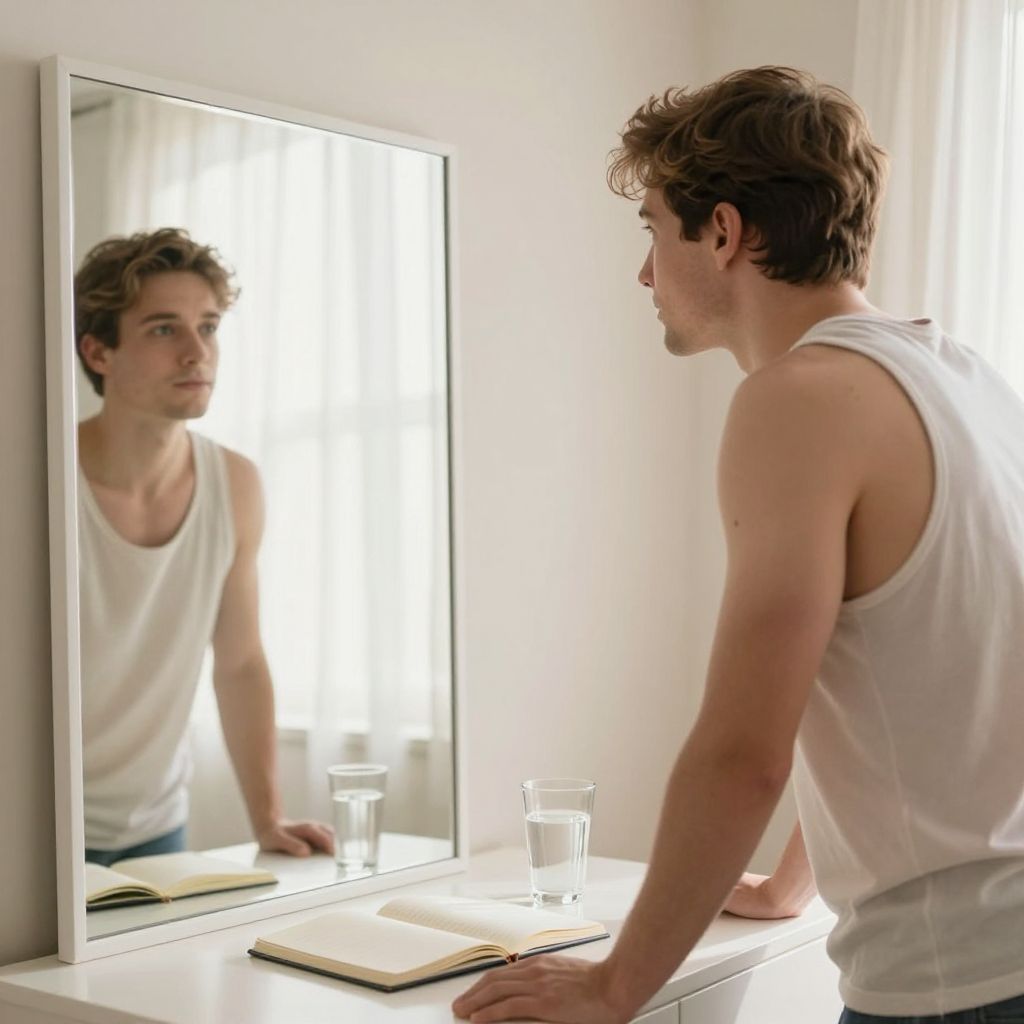
You type the question into a search bar late at night, and you feel a tight knot in your chest. The worry sits there, heavy and persistent, and you wonder if what you see in the mirror matches what everyone else sees. The truth is, most people asking this question are not objectively unattractive at all.
What they experience is a distorted perception shaped by bias, comparison, and a culture that profits from insecurity. Research in social psychology shows that self-perception is far less reliable than we assume, and the standards we use to judge ourselves are often unrealistic, inconsistent, and deeply influenced by context.
How Do You Tell If You Are Ugly?
You cannot accurately judge your own attractiveness because your perception is distorted by familiarity, mood, lighting, and cognitive bias. Objective attractiveness exists on a spectrum shaped by symmetry, averageness, and cultural context, but most people fall into an average range where personality, grooming, and confidence matter far more than raw features.
Why You Cannot Trust Your Own Judgment
Your brain processes your own face differently than it processes the faces of others. The mere-exposure effect, documented by psychologist Robert Zajonc, shows that repeated exposure to a stimulus increases liking for it, but this effect reverses when you see yourself in photos or videos.
You see yourself most often in mirrors, which show a reversed image. When you see a photograph, your brain registers the non-mirrored version as unfamiliar and often less attractive.
Your self-assessment also shifts dramatically based on your emotional state. Studies in cognitive psychology demonstrate that depression and anxiety distort visual perception, making people rate their own attractiveness significantly lower during low mood states.
You judge yourself in high-definition detail, while you view others as complete gestalts. You fixate on a single feature you dislike and let it dominate your entire self-image, a phenomenon called feature-based self-evaluation.
The Role of Body Dysmorphic Disorder
Approximately 2% of the population experiences Body Dysmorphic Disorder (BDD), a condition where a person obsesses over perceived flaws that are minor or nonexistent. BDD sufferers spend hours checking mirrors, seeking reassurance, or avoiding social situations entirely.
If you spend more than an hour daily thinking about your appearance, feel intense distress about specific features, or avoid social situations because of appearance concerns, you may meet criteria for BDD. This is a clinical condition that responds to treatment, not a reflection of objective ugliness.
What Science Says About Attractiveness
Universal Standards Versus Cultural Variation
Cross-cultural research identifies a few universal markers of facial attractiveness: symmetry, averageness, and sexual dimorphism (masculine features in men, feminine features in women). These preferences appear across different cultures and emerge early in infancy.
However, these universal preferences explain only part of the picture. Cultural context, personal experience, and individual variation create massive differences in what people find attractive.
Studies using composite faces show that mathematically average faces are rated as more attractive than most individual faces. This contradicts the idea that beauty requires exceptional or striking features.
Most people fall within the average range of attractiveness, which means that grooming, health, and presentation become the deciding factors.
The Halo Effect and First Impressions
Attractive people benefit from the halo effect, where positive traits in one domain (like appearance) lead observers to assume positive traits in other domains (like intelligence or kindness). This effect is real and measurable in employment, education, and social settings.
But the halo effect works both ways. People who display warmth, competence, and confidence are perceived as more physically attractive, even when their features remain unchanged.
Practical Ways to Assess Your Appearance Objectively
1. Ask Trusted People Directly
Select three to five people who know you well and have no reason to flatter or harm you. Ask them to rate your attractiveness on a scale from 1 to 10, and specify that you want honesty, not kindness.
If most responses cluster between 5 and 7, you fall within the average range. This is where most people land, and it means that your attractiveness is highly malleable based on other factors.
2. Use Photo Rating Platforms With Caution
Websites and apps that crowdsource attractiveness ratings can provide data, but they come with significant limitations. Users on these platforms skew younger and judge photos, not people in motion.
Photos eliminate vocal tone, body language, and the dynamic quality of real human interaction. They also encourage harsh judgment because the stakes feel low and the person feels distant.
If you use these tools, submit multiple photos in different lighting and contexts, then average the results. A single photo rating tells you almost nothing reliable.
3. Evaluate Your Grooming and Presentation
Research consistently shows that grooming, fitness, and style have a larger impact on perceived attractiveness than facial structure for most people. A study published in Evolution and Human Behavior found that women rated men significantly higher in attractiveness after changes in grooming and clothing, even when facial features remained identical.
Ask yourself these questions with genuine honesty:
- Do you maintain basic hygiene, including clean hair, trimmed nails, and fresh breath?
- Do your clothes fit properly, or do you wear oversized or dated styles?
- Do you exercise regularly enough to maintain a healthy body composition?
- Do you get adequate sleep, hydration, and nutrition?
- Do you smile and make eye contact in social settings?
If you answered no to two or more of these questions, your perceived attractiveness is likely far below your potential, regardless of your features.
4. Record Video of Yourself in Social Situations
Static images distort reality because humans are dynamic. Set up a camera during a casual conversation with friends, then watch the footage a week later.
You will likely notice that you appear far more natural, animated, and engaging than you do in photos. You will also spot habits you can improve, like posture, vocal energy, or facial tension.
Understanding the Attractiveness Bell Curve
Where Most People Actually Fall
Attractiveness follows a normal distribution. Roughly 68% of people fall within one standard deviation of average, meaning they are neither ugly nor conventionally beautiful.
Only about 2-3% of people are at the extreme low end of attractiveness due to severe asymmetry, facial deformity, or other significant physical differences. If you function normally in social settings without people openly reacting to your appearance, you almost certainly do not fall into this category.
The remaining 97% of people exist on a spectrum where context, presentation, and personality determine most of their romantic and social outcomes. This is good news, because these factors are within your control.
The Danger of Online Comparison
Social media platforms flood your brain with images of the top 1% of attractiveness, creating a distorted baseline. Your brain begins to treat these outliers as normal, making average attractiveness feel like failure.
A study in Body Image found that just 30 minutes of Instagram use significantly decreased body satisfaction in women. The mechanism is simple: you compare your everyday reality to someone else’s curated highlight reel.
You are not competing with models and influencers in your actual life. You are navigating real-world environments where kindness, humor, competence, and warmth matter enormously.
What Actually Matters More Than Raw Attractiveness
Confidence Without Arrogance
Confidence changes how people perceive your physical features. Research in social psychology shows that confident body language, steady eye contact, and relaxed facial expressions all increase perceived attractiveness ratings.
Confidence does not mean pretending you are perfect. It means accepting your appearance without shame or constant self-monitoring.
Social Skills and Likability
People who make others feel comfortable, who listen well, and who contribute positively to group dynamics are remembered as more attractive. This effect intensifies over time as people get to know you.
Studies on long-term relationship formation show that physical attractiveness matters significantly for initial encounters but diminishes in importance as familiarity increases. Personality traits become the dominant factor in sustained attraction.
Purpose and Competence
People engaged in meaningful work, who develop skills, and who contribute to their communities carry themselves differently. They display what researchers call “social proof,” a signal that others value them.
This is not superficial advice. Purpose genuinely changes your facial expressions, posture, and energy in ways that register unconsciously to others.
When Professional Help Makes Sense
Cosmetic Intervention Versus Psychological Support
Some physical changes yield measurable improvements: losing excess weight, fixing dental issues, treating severe acne, or correcting significant asymmetry through surgery. These interventions work best when motivated by self-directed goals, not desperate attempts to meet external standards.
However, if your distress about appearance persists despite reassurance, grooming improvements, and social success, you likely face a psychological issue, not a physical one. Therapy, particularly Cognitive Behavioral Therapy (CBT), treats BDD and appearance-related anxiety effectively.
A therapist can help you identify distorted thinking patterns, reduce compulsive checking behaviors, and build a healthier relationship with your appearance.
Building a Realistic and Healthy Self-Image
Accept the Limits of Control
You cannot control your bone structure, your height, or your basic facial features. You can control your fitness, your grooming, your skills, your kindness, and your contribution to the world.
Maturity means investing energy where you have agency and releasing anxiety where you do not.
Shift From Judgment to Function
Instead of asking “Am I ugly?” ask “Does my appearance prevent me from doing what I want to do?” If you have friends, romantic interest from people you respect, and the ability to move through the world without harassment, your appearance is functional.
Function matters more than ranking. Life is not a beauty contest, and most people are too focused on their own concerns to scrutinize yours.
Surround Yourself With People Who Value Substance
If everyone around you obsesses over appearance, you will internalize those values. If you spend time with people who value creativity, integrity, humor, and competence, you will internalize those instead.
Your social environment shapes your self-concept more than you realize. Choose it carefully.
Moving Forward
The question “Am I ugly?” often masks deeper concerns about belonging, worth, and love. You fear that your appearance disqualifies you from connection, but connection depends far more on vulnerability, consistency, and care than on facial symmetry.
Most people are not ugly. Most people are average, which means they are judged primarily on qualities they can develop.
If you maintain basic grooming, treat your body with respect, develop skills that matter to you, and engage with others authentically, your appearance will not hold you back. The fear that it will is usually the bigger obstacle than the appearance itself.
Stop asking if you are ugly. Start asking if you are living with courage, building relationships that matter, and treating yourself with the same compassion you would offer a good friend. The answer to those questions shapes your life far more than your bone structure ever will.
If you found this article helpful, you might also benefit from exploring related topics on self-perception and personal growth. Understanding how to see yourself from an outside perspective can shift your relationship with your appearance entirely. Learning to be by yourself comfortably also builds the inner stability that makes external validation less urgent.